Our members have been active in disseminating state-of-the-art science on water indicators and advancing the field of wastewater surveillance.
Dr. Marlee Shaffer (former lab member) and Bethany Oceguera Johsnon recently identified the plasmid pBI143 as a highly promising and abundant process indicator for monitoring antibiotic resistance gene (ARG) removal in wastewater treatment plants. By tracking nine clinically relevant ARGs across different treatment stages, they found that pBI143 strongly correlated with the removal efficiency of most ARGs, suggesting it can serve as a reliable, single metric to streamline the assessment of ARG reduction through activated sludge wastewater systems. Link to the paper: https://pubs.acs.org/doi/abs/10.1021/acsestwater.5c00883
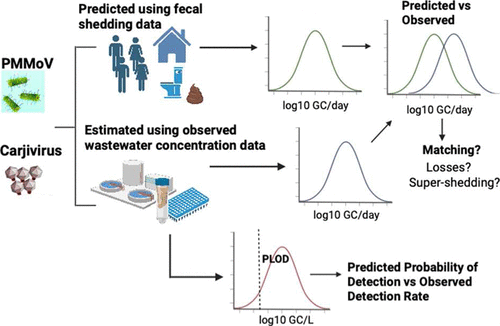
More recently, Dr. William Chen's PhD work focused on validating Wastewater-Based Epidemiology (WBE) models that estimate community disease trends from sewage. In his last study, he compared model predictions to observed wastewater concentrations of the fecal indicators Pepper Mild Mottle Virus (PMMoV) and Carjivirus, and we confirmed the models' robustness in predicting pathogen detection likelihoods. The analysis highlighted that WBE models using average shedding rates often underestimate true wastewater concentrations likely due to "super-shedders" (individuals who shed higher amounts of virus) or accumulation within the sewage network. His research showed that failing to account for these factors could lead to a significant overestimation of disease prevalence. Link to the paper: https://pubs.acs.org/doi/abs/10.1021/acs.est.5c13484